
How to Run as a Write-In Candidate in Illinois: A Practical Guide
Write-in candidates are a unique feature of Illinois elections. They allow qualified individuals to run for office without appearing on the printed ballot. Voters simply write the candidate’s name in the designated space. While this option provides flexibility, it comes with strict procedural requirements under the Illinois Election Code. Missing a single deadline can mean your votes are never counted.
A write-in candidate is someone whose name does not appear on the ballot, but who still seeks election. Illinois law (10 ILCS 5/7-59, 17-16.1, and 18-9.1) provides a clear path: you must formally notify election officials in advance that you intend to run as a write-in. Without this filing, no votes cast for you will be tabulated, even if voters write your name in large numbers.
The basic steps for becoming a write-in candidate include:
- Confirm You Meet Basic Qualifications. You must satisfy the eligibility requirements for the office you seek (age, residency, citizenship, voter registration, etc.). Certain offices also prohibit you from running as a write-in if you were defeated in the primary for the same office and party in the same election cycle.
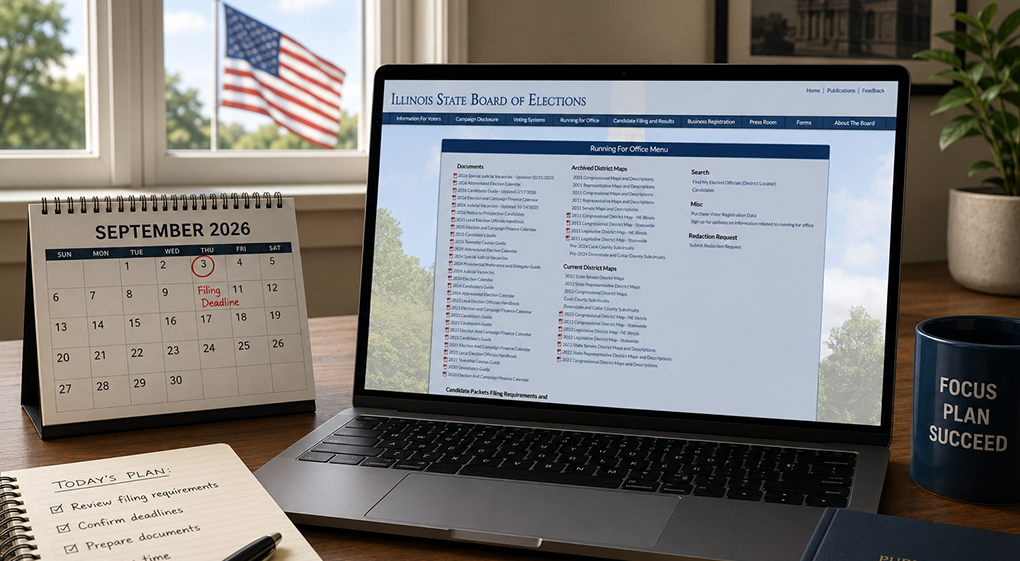
- Complete the Required Form. File a notarized Declaration of Intent to Be a Write-In Candidate (Form P-1F). This is a simple one-page form available from your local election authority or the Illinois State Board of Elections website
- File with the Proper Election Authority. Submit the original, notarized form (wet signature required) to the correct office(s):
- County Clerk for most local, county, and some state legislative offices.
- Multiple authorities if the office spans jurisdictions.
- Not the State Board of Elections for local races.
- Meet the Filing Deadline. The declaration must be filed no later than 61 days before the election. There is a narrow exception: if a petition challenge removes a candidate’s name from the ballot after the 61-day deadline, you may file up to 7 days before the election.
If you are wondering if you may still run as a write-in candidate for the November 3, 2026, General Election, the answer is “yes”. The 61-day deadline falls on September 3, 2026. You have ample time to prepare, consult counsel, and file properly. Early planning is always recommended to avoid last-minute issues.
If you receive the most votes as a write-in, there is work to be done relatively soon following your victory. You must file a Statement of Candidacy and receive a receipt for filing your Statement of Economic Interests (with limited exceptions for federal or party offices) before taking office. These post-election filings are mandatory and have their own tight deadlines.
Running as a write-in is often a strategic last resort in instances, for example, after a successful petition challenge against you or when time does not allow a full nominating petition drive. It requires far fewer signatures than a regular candidacy but demands precise compliance with timing and paperwork. Even a small error can disqualify every vote cast for you.
At Lavelle Law, our Election Law Practice Group regularly assists candidates with write-in declarations, petition challenges, and post-election compliance. We help ensure your intentions translate into counted votes and a smooth path to taking office.
If you are considering a write-in campaign for the November 2026 election (or any upcoming race), contact us early. Our team can review your eligibility, prepare the necessary forms, and guide you through every step.
Should you have additional questions regarding running for public office in Illinois or even at the federal level, please call Lavelle Law at 847-705-7555 or email Attorneys John (Jack) Lydon (lydonj@lavellelaw.com), Annette Corrigan (acorrigan@lavellelaw.com), or Jacob Rotolo (jrotolo@lavellelaw.com) to schedule your free and confidential one-hour consultation.
Annette Corrigan is a member of Lavelle Law’s Election Law Team. With extensive legal experience both in and out of the courtroom, she brings depth and practicality to her practice. When she is not advocating for her clients or spending time with her family, Annette is deeply committed to community service.
In 2019, she won elected office after running a successful grassroots campaign. Upon completing her term in 2024, she was asked to run as a write-in candidate for another office and earned a record number of write-in votes in the primary, successfully securing a place on the general election ballot. Annette earned both her undergraduate and law degrees from Marquette University.
More News & Resources
Lavelle Law News and Events