
Why ChatGPT Can’t Be Your Attorney

Sarah J. Reusché and Shelley McCarthy • July 17, 2026
Why ChatGPT Can’t Be Your Attorney
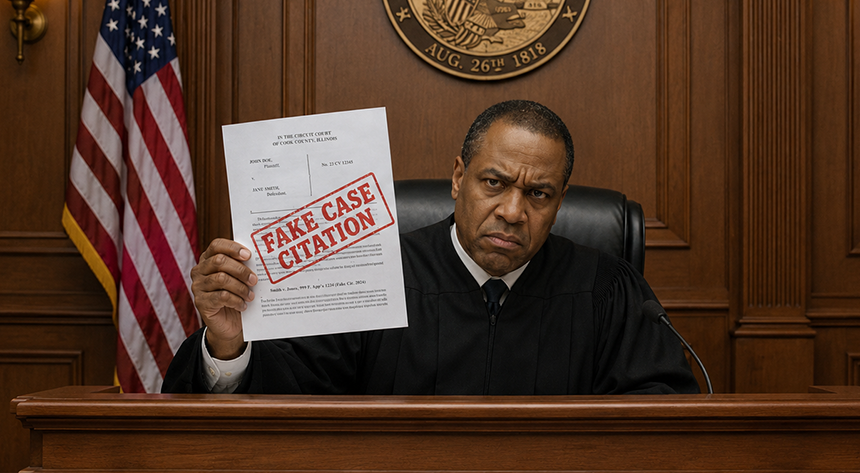

Thinking about using AI to represent yourself in litigation? Think again. It is well-documented that pro se litigants (those who represent themselves) are less likely to prevail compared to their represented counterparts, due to a lack of procedural and substantive legal knowledge. Regardless, AI has provided people with a false sense of security, tempting them to represent themselves regardless of the statistical realities and consequences. For experienced attorneys – like those at Lavelle Law – AI errors are obvious. But for pro se litigants, blind confidence in AI-generated “legal advice” can be costly.


More judges are becoming less tolerant of litigants making misrepresentations in pleadings based on what AI tells them. As the use of AI in the courtroom has increased, courts have not hesitated to impose sanctions for AI misuse where parties cite fake cases and false arguments due to overreliance on AI. Sanctions may include monetary penalties, requirements to donate to a legal charity, or dismissal.


Why is it Unreasonable to Rely on AI for Legal Advice?


There has been adequate warning from multiple trusted sources that legal information provided by AI is prone to contain errors and cite inaccurate or nonexistent cases.


In 2024, the American Bar Association issued Formal Opinion 512 regarding AI, in which it warns that generative AI tools are prone to “hallucinations.” Hallucinations in this context have become known in the legal community as AI responses that have no basis in fact or reality. The ABA explains that AI is trained on limited and potentially outdated content, with tools that lack the ability to understand the meaning of text or evaluate context. As a result, AI hallucinations often cite nonexistent cases as fake support for a statement.


Many AI systems are not trained on case law but rather only rely on secondary sources to generate responses that simply sound right – like Reddit comments, for example. A study from Stanford concluded that the statistical probability that an AI response contains factual errors, irrelevant information, or is not grounded in the jurisdictions governing case law is much too high for parties to trust the AI response blindly for legal research. Therefore, AI should never be used to supplant an attorney’s professional judgment.


Hiring a licensed attorney brings the following benefits that AI simply can’t compete with:


  1. Representation required by law – most businesses are legally required to be represented by a licensed attorney in court.
  2. Courtroom advocacy – reading the judge’s tone and the jury, adapting arguments in real time, and persuasive candor.
  3. Novel legal issues – attorneys are equipped to think critically and fill in the gaps in the law with experience in other cases and persuasive arguments based on other jurisdictions.
  4. Confidentiality – having a real attorney creates the attorney/client privilege.
  5. Relevant arguments – attorneys are trained to identify which facts are important and which are irrelevant.
  6. Settlement advantage – negotiation skills require human judgment, persuasion, nuance, and appeal to emotions.


If you’re considering representing yourself in litigation, contact Lavelle Law Attorney Sarah Reusché instead at sreusche@lavellelaw.com or 847-705-7555. Free initial consults are available. 


Attorney Sarah Reusché is part of the extensive Litigation team at Lavelle Law, one of the most trusted law firms in the Chicago area. Reusché is licensed to practice law in multiple states and has successfully represented clients in cases covering personal and corporate liability. She is a frequent presenter at legal and corporate seminars and industry trade association meetings.

More News & Resources

Lavelle Law News and Events

Representation and Warranties Insurance Democratization: A Game Changer for Many Deals
By Steven A. Migala July 13, 2026
Representations and warranties insurance (“RWI”) for mergers and acquisitions (“M&A”) is more accessible than ever due to increasing democratization in the market. Now, RWI can be a viable option for smaller, mid-market deals.
IRS Announces Simplified Penalty Relief
By Timothy M. Hughes July 10, 2026
On July 8, 2026, the Internal Revenue Service announced a new automatic process to provide penalty relief for taxpayers with a history of filing and paying on time, reducing the need for those taxpayers to request assistance in addressing penalty relief.
NDAs in the Spotlight: What Swift and Kelce’s Wedding Reveals About Protecting Your Privacy.
By Theodore M. McGinn June 30, 2026
High-profile couples like Taylor Swift and Travis Kelce are taking strict steps to protect their privacy. Reports confirm that wedding guests must sign non-disclosure agreements (NDAs) before receiving event details. This highlights how NDAs help individuals and businesses safeguard sensitive information.
Gross Lease vs. Net Lease: Which is Better for Your Business?
By Theodore M. McGinn June 29, 2026
For many businesses, the commercial lease is the largest single expense each year. But are you actually getting the best deal, or are you unknowingly paying for hidden costs? In this Lavelle Law Minute, Attorney Ted McGinn breaks down the two most common commercial leases: Gross Leases and Net Leases.
Cubs Legend Ryne Sandberg’s Family Heads to Court Over Mishandling of Trust
By Brian I. Warens June 25, 2026
Cubs Hall of Famer Ryne Sandberg, affectionately known as “Ryno,” is forever remembered for his legendary “Sandberg Game.” Sadly, his death last July has since triggered a bitter family dispute, with his children now suing his widow, Margaret Sandberg, over alleged violations of his trust.
Success Story - $7.5 Million Ukrainian Village Commercial Land Sale
By Commercial Real Estate June 23, 2026
This transaction highlights Lavelle Law’s deep expertise in managing complex commercial real estate deals in Chicago’s dynamic market, delivering efficient, client-focused outcomes even under accelerated timelines.
SCOTUS Rules SEC Can Seek Disgorgement Without Proving Victim Financial Loss
By Steven A. Migala June 22, 2026
The U.S. Supreme Court issued a unanimous ruling on June 4, 2026, in Sripetch v. Sec. & Exch. Comm’n, clarifying a significant question in securities enforcement. The Securities and Exchange Commission (SEC) does not need to identify victims who suffered actual financial harm to pursue disgorgement of ill-gotten gains.
IRS Announces Nationwide Hiring Events
By Timothy M. Hughes June 10, 2026
On June 4, 2026, the Internal Revenue Service announced a series of hiring events to take place across the country through the end of July 2026. The events are aimed at recruiting individuals for key seasonal roles, including customer service representatives and tax examining technicians.
So, You Want to Run for Office?
Meeting the Basic Eligibility Requirements is the First Step
By Annette K. Corrigan June 5, 2026
Before you print a single petition or launch a campaign website, the first and most important question is this: Am I eligible to run for this office? In Illinois, failing to meet the basic eligibility requirements can disqualify a candidate before the race even begins. Understand the rules upfront.
“Entrepreneurial Boot Camp” outlines key legal and structural decisions every founder should know.
By Theodore M. McGinn and Frank J. Portera May 27, 2026
This Lavelle Law Breakfast Briefs seminar highlighted actionable insights to protect and position your business for success, including: business entity selection; capital structure; key contract terms; and shareholder and operating agreements.
More Posts